

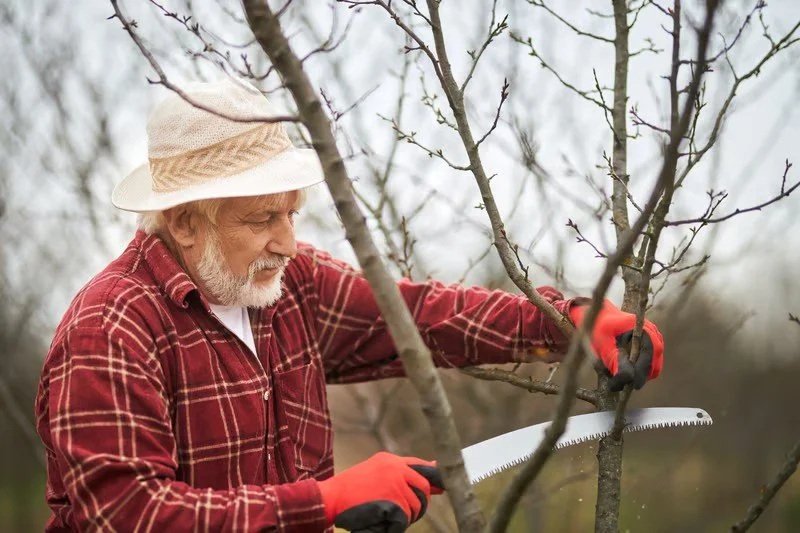
Blueberry Pruning Guide
The native edible that doubles as an ornamental — and the fruiting-wood system that determines how much you harvest
Why Blueberry Pruning Is Different
You're not pruning for shape or bloom — you're pruning for the harvest
Every other guide in this library manages pruning around flowers, foliage, or overall form. Blueberry shifts that equation entirely. The pruning system exists to maximize fruit production over decades while maintaining both plant health and an attractive ornamental presence at the same time. This means genuinely understanding fruiting wood, which stems carry the most and best berries, how old those stems should ideally be, and when to replace them before they start declining, in a way no other shrub in this library demands. Get the system right and a well pruned highbush blueberry produces reliably heavy crops from year four through year forty, an extraordinary production lifespan for a landscape shrub. Ignore pruning entirely and production drops steadily after year eight as the bush fills up with aging wood that carries fewer and smaller berries every season.
Blueberry also happens to be one of the most genuinely beautiful multi season native shrubs available for Seacoast gardens, which makes the investment in proper pruning worth it even before you factor in the fruit. White bell shaped spring flowers, edible summer fruit, brilliant orange-red fall foliage that rivals any burning bush, and exfoliating coral red winter bark on mature stems, all on a deer resistant, non-invasive native that genuinely thrives in the acidic, sandy soils common throughout coastal New Hampshire. We recommend it constantly as a burning bush replacement for good reason. It outperforms the invasive in every season except possibly October, and even then it's genuinely competitive. But the pruning system here is more specific than what purely ornamental shrubs require, because the fruit is the primary return on the investment a homeowner is making in this plant.
Need an experienced hand with your blueberries? Call Expert Pruning at (603) 999-7470.
Our Master Gardener-led team prunes blueberries for production — the fruiting-wood renewal cycle, variety-specific timing, and the soil management that supports heavy cropping year after year on Seacoast properties from Portsmouth to Kittery.
Two Plants, Two Systems: Highbush vs. Lowbush
Know which you have before you pick up the pruners
♦ Highbush Blueberry (Vaccinium corymbosum)
This is the blueberry of commerce, the one sold at nurseries, planted in edible gardens and ornamental landscapes alike, and the one this guide primarily addresses throughout. Highbush varieties grow four to eight feet tall as upright, multi-stemmed shrubs, with distinct individual canes emerging directly from the crown of the plant. They produce the large, familiar berries you'd recognize from a grocery store or farmers market. The fruiting wood system matters intensely on this type because production quality is directly tied to cane age. Stems in their second through fifth year carry the heaviest crops of the largest berries, while older stems produce progressively smaller fruit on weaker laterals until they eventually become net liabilities the plant is wasting energy maintaining.
Highbush blueberries require genuinely acidic soil, a pH between 4.5 and 5.5, consistent moisture, and at least six hours of direct sun for good production. The sandy, naturally acidic soils common along the Seacoast from Rye through Kittery are often close to ideal with only minimal amendment needed. Sulfur or peat incorporation may be necessary on heavier clay or more neutral pH sites further inland toward Exeter or Durham. Cross pollination between two or more varieties planted within twenty feet of each other increases berry size and overall crop load by twenty to thirty percent, which is why we always recommend planting at least two different cultivars rather than a single variety alone.
♦ Lowbush Blueberry (Vaccinium angustifolium)
This is the native wild blueberry of Maine and northern New England, a spreading groundcover running six to eighteen inches tall that colonizes an area through underground rhizomes over time. Lowbush produces tiny, intensely flavored berries prized for baking and preserves, and it provides spectacular scarlet fall color as either a groundcover or an edging plant. It's genuinely ornamental as well as edible, making it an exceptional living mulch beneath highbush plantings or a standalone groundcover for a sunny, acidic bank.
Lowbush pruning works entirely differently from highbush, and it's a much simpler system overall. Commercial wild blueberry growers manage lowbush on a two year cycle, mowing or burning the entire patch to ground level in alternating years, which produces a vegetative regrowth year followed by a heavy fruiting year. For home gardens, simply mow or cut the patch back to two to three inches every other March. The off year produces the leafy growth that becomes the following year's fruiting wood. There's no selective cane management here and no thinning required, just a straightforward biennial reset. The scarlet fall color shows up in both years of the cycle regardless.
Fruiting-Wood Biology: Why Cane Age Matters
The science behind the pruning system
Understanding how blueberries actually produce fruit is the key to pruning them well, and it's worth taking the time to genuinely understand this rather than just following steps mechanically. Each highbush cane moves through a predictable life cycle. In its first year, a new cane grows vigorously upward, producing leaves but no fruit at all yet. In its second year, short lateral branches called fruiting spurs develop along the upper portion of the cane, and each of those spurs carries a cluster of flower buds that will become berries. Years two through five represent the prime production window, where the cane carries abundant fruiting spurs with large, high quality berries on genuinely strong laterals. After year five, the cane begins a real decline. Fruiting spurs become shorter and weaker, berry size decreases noticeably, and total production drops even as the cane continues taking up space and intercepting light that younger, more productive stems actually need.
By year seven or eight, an old cane is producing perhaps thirty to forty percent of what it carried during its prime years, and the berries it does produce are noticeably smaller than what the same plant produced just a few seasons earlier. By year ten, that cane has become a thick, gray barked trunk producing almost nothing at all while still consuming root resources that could otherwise support three vigorous young canes occupying the same space. This is exactly why blueberry pruning is fundamentally a cane replacement system at its core. You're constantly cycling out old, declining wood and replacing it with new canes that will enter their own prime production window roughly two years later.
The visual cue that tells you where each cane stands in this cycle is bark color. Young canes, one to three years old, show red, coral, or reddish brown bark, the same exfoliating color that makes blueberry so ornamentally attractive in winter when little else in the garden has any color at all. Mature canes in the four to six year range turn gray brown. Old canes at seven years or beyond become thick, gray, and rough barked. If most of your bush consists of gray trunks at this point, you've almost certainly been under-pruning, and production has likely been declining quietly for several years already.
The Annual Pruning Protocol (Late Winter — March)
Five steps in priority order, every year, on every highbush plant
♦ Step 1: Remove Dead, Damaged, and Diseased Wood
Start every pruning session by cutting out anything dead. A simple snap test tells you what you're dealing with: dead wood is dry and brittle and snaps cleanly, while live wood bends and shows green cambium underneath the bark when nicked. Remove anything broken or showing signs of disease as well, cankers, unusual discoloration, or remnants of mummy berry infection from the previous season. Cut back to clearly healthy wood or all the way to the ground if the whole cane is compromised. This step is non-negotiable cleanup that improves airflow and removes pathogen reservoirs regardless of the plant's overall age or condition.
♦ Step 2: Remove the Oldest Canes
Identify the two or three oldest, thickest, gray barked canes on the bush and cut them at ground level. These are the stems past their production prime, large diameter trunks with rough gray bark, short weak laterals, and small or sparse fruiting spurs that simply aren't contributing much anymore. Removing them redirects the plant's energy toward younger, more productive stems and opens up interior space for better light and airflow. On a mature bush carrying twelve to eighteen canes, removing two to three of the oldest each year keeps the overall framework dominated by stems sitting in their productive two-to-six-year window.
A useful guideline here is what we call the one sixth rule. Aim to remove roughly one sixth of the total cane count each year. This effectively gives each cane an approximate six year lifespan within the bush, entering its prime in year two, peaking through years three to five, and being removed in year six before it has the chance to decline significantly. The bush stays in a state of constant renewal without ever losing more than a fraction of its overall fruiting capacity in any single season.
♦ Step 3: Thin Weak and Crossing Interior Wood
Remove any spindly, weak canes thinner than a pencil that simply won't support a meaningful fruit load even if left in place. Remove canes that cross through the center of the bush as well, rubbing against neighboring stems or blocking light from reaching the interior. The overall goal is an open vase shape where light can reach the interior fruiting spurs, since berries developing in shade end up smaller, less sweet, and ripen unevenly compared to berries with good light exposure. A well pruned blueberry typically has six to eight strong, well spaced main canes with genuine room between them for air circulation and light penetration.
♦ Step 4: Reduce Excessive Fruit Bud Load
This is the step most home gardeners skip entirely, and it's also the one that makes the biggest difference in actual berry quality once it's done consistently. Each flower bud cluster produces five to eight berries. A vigorous young cane might carry thirty to fifty fruit bud clusters, which translates to somewhere between one hundred fifty and four hundred potential berries on a single stem. If every one of those buds sets fruit, the cane simply can't size them all adequately, and you end up with a heavy crop of small, mediocre berries instead of a more moderate crop of large, intensely flavored ones.
The tip back technique addresses this directly. On each remaining cane, remove the top two to four inches of the previous year's growth, cutting back to a strong outward facing bud. This removes the densest cluster of fruit buds right at the tip, where they're most crowded and produce the smallest berries anyway, and redirects the plant's energy into fewer but larger fruit from the remaining buds positioned lower on the cane. The practical result is twenty to thirty percent fewer berries by count but berries that run thirty to forty percent larger by weight, with noticeably better concentrated flavor. Total yield by weight ends up comparable either way, but the eating quality is dramatically better with this approach.
♦ Step 5: Remove Low-Hanging and Ground-Level Growth
Cut away any branches drooping toward the ground or growing laterally below twelve inches in height. Fruit developing on these low branches sits within mud splash range during rain, picks up soil-borne disease more readily, ripens unevenly in the shade beneath the rest of the canopy, and is typically the first target for chipmunks and ground feeding birds looking for an easy meal. Removing this low growth also improves airflow at the base of the plant, where fungal pressure tends to run highest, and it genuinely makes mulching, weeding, and harvesting easier throughout the rest of the season.
Tools for Blueberry Pruning
For tip-backs, lateral thinning, and removing stems up to 3/4 inch — the primary tool for 80% of the work.
For removing old main canes at ground level (1–2 inch diameter).
For the thickest old trunks on neglected bushes.
Varieties for the Seacoast: Early, Mid, and Late Season
Plant across the harvest window for six weeks of fresh fruit instead of two
The single most impactful variety decision for Seacoast homeowners is genuinely planting across the harvest window rather than choosing just one variety. A single mid season variety gives you two to three weeks of ripe fruit sometime in July. Three varieties together, one early, one mid, one late, extend that harvest from late June all the way through early August, six full weeks of fresh blueberries from the same garden. Cross pollination among the three also increases berry size and total yield on every plant in the planting, not just a modest bonus but a genuine production benefit. This is the planting strategy we recommend for essentially every edible blueberry installation from Portsmouth to Stratham.
| Variety | Season | Size & Character |
|---|---|---|
| Early Season (late June – early July) | ||
| 'Patriot' | Early | 4–6 ft; extremely cold-hardy; large berries; excellent flavor; reliable Seacoast performer |
| 'Earliblue' | Early | 5–6 ft; large light-blue fruit; mild sweet flavor; vigorous upright habit |
| 'Duke' | Early | 4–6 ft; very consistent; firm berries; good for fresh eating; needs good drainage |
| Mid Season (mid July) | ||
| 'Bluecrop' | Mid | 5–6 ft; the industry standard; reliable heavy producer; good flavor; drought tolerant |
| 'Blueray' | Mid | 4–6 ft; outstanding flavor; large berries; excellent ornamental fall color |
| 'Chandler' | Mid | 5–6 ft; the largest berries of any variety; extended harvest; vigorous |
| 'Toro' | Mid | 4–5 ft; compact; very large berries; excellent flavor; good container candidate |
| Late Season (late July – August) | ||
| 'Jersey' | Late | 5–7 ft; old reliable; smaller berries but extremely heavy producer; vigorous |
| 'Elliott' | Late | 5–7 ft; firm tart berries; extends season into August; excellent for preserves |
| 'Darrow' | Late | 4–6 ft; very large flavorful berries; moderate yield; upright habit |
| Half-High Hybrids (compact / coldest sites) | ||
| 'Northland' | Early-Mid | 3–4 ft; half-high hybrid; extremely hardy; heavy producer; good for hedges |
| 'Polaris' | Early | 3–4 ft; half-high; aromatic berries; compact; excellent for small gardens |
| 'Chippewa' | Mid | 3–4 ft; half-high; large sweet berries; compact upright form; very ornamental |
| Lowbush (groundcover / ornamental) | ||
| V. angustifolium (wild) | Mid | 6–18 in; native groundcover; tiny intense berries; biennial mow cycle; scarlet fall color |
| 'Burgundy' | Mid | 8–12 in; selected lowbush; burgundy fall color; ornamental edging; biennial mow |
Our Seacoast three variety recommendation runs 'Patriot' for early season, 'Bluecrop' for mid season, and 'Jersey' or 'Elliott' for late season. This combination delivers a full six weeks of harvest, cross pollinates heavily across all three plants, performs reliably under Zone 6b coastal conditions, and is available at most regional nurseries without much searching. All three are vigorous, disease resistant, and respond well to the annual pruning protocol described above. For smaller gardens or foundation plantings where three to four foot plants fit the space better, substitute half-high hybrids instead: 'Polaris' for early, 'Chippewa' for mid, and 'Northland' for an early-to-mid extended season.
The First Four Years: Building the Framework
Delayed gratification that pays compound interest
♦ Years 1–2: Remove All Flower Buds
This is genuinely the hardest piece of advice in this entire guide, and also the most important one to follow. Strip every flower bud from newly planted blueberries during their first two springs in the ground. Yes, all of them, even though it feels wrong to do. The plant wants to fruit immediately given the chance, but allowing it to do so diverts energy away from root establishment and cane development and into a small crop of fairly mediocre berries that ends up delaying the timeline to full production by a year or two overall. A blueberry that invests its first two years entirely into root mass and cane structure enters year three with a framework genuinely capable of supporting a serious crop. One that was allowed to fruit from the very start enters year three still playing catch up on that same structural development.
Flower buds are easy to identify once you know what to look for, the fat, round buds clustered at the tips of the previous year's growth, distinctly different in shape from the smaller, pointed vegetative buds found lower down on the same cane. Rub them off by hand or simply clip the tips back in March before they have the chance to open.
♦ Year 3: Allow Light Fruiting
Allow approximately half the flower buds to remain on the plant this year, removing the rest by tipping canes back three to four inches. This gives you a modest first harvest while the plant continues building out its cane structure in the background. Expect somewhere around a quart or two per bush, which is plenty to confirm you planted the right varieties in the right spot without asking too much of a plant that's still establishing.
♦ Year 4+: Full Production Pruning
Begin the complete annual protocol described in detail above. The bush should now have eight to twelve canes of varying ages, with the oldest sitting around four years old at this point. From here forward, the renewal cycle maintains production indefinitely, removing the oldest one sixth each year, tipping back for berry quality, thinning for light and airflow, and allowing new basal canes to replace whatever gets removed in the process. A well managed highbush blueberry reaches peak production somewhere around years six through eight and then maintains near-peak performance for decades afterward with consistent annual attention.
Renovating Neglected Bushes
Old, overgrown, unproductive — but almost certainly salvageable
A blueberry that hasn't been pruned in a decade is typically a dense thicket of twenty to thirty canes, mostly old gray wood at this point, producing small berries only at the very tips of the tallest stems where they manage to get enough light. The interior is usually a tangle of weak, crossing branches with essentially no air movement through it. This plant is genuinely still alive and healthy in most cases, just structurally exhausted, spending most of its available energy maintaining wood that's producing almost nothing in return.
A two year renovation is what we typically recommend. In year one, remove half the canes at ground level, choosing the oldest, thickest, and most congested ones first. Leave the youngest and most productive looking stems in place. The bush will look dramatically thin immediately afterward, but it redirects energy into the remaining canes right away and begins pushing vigorous new basal growth within the same season. In year two, remove the remaining old wood and begin the standard annual protocol on what's now a genuinely new framework. You'll sacrifice most of the crop in year one and get a light crop in year two, with near full production returning by year three on young, vigorous wood.
A more aggressive complete renovation is also an option for bushes too far gone for the staged approach. Cut the entire bush down to four to six inches in March. Blueberry resprouts well from the crown given good conditions, but the rebuild takes longer overall than the two year approach, with minimal fruit expected in years one and two and the framework not maturing enough for serious production until year three or four. This is the right approach when a bush is so congested that identifying and selecting individual canes for the staged method simply isn't practical anymore. On properties across Greenland and North Hampton where blueberries were installed fifteen to twenty years ago and never pruned since, we typically recommend the two year approach for plants still showing some productive wood, and complete renovation for plants that have become essentially all gray trunk with little else left.
Soil, Mulch, and Aftercare
The pruning system only works if the soil supports it
Blueberries require genuinely acidic soil, a pH between 4.5 and 5.5, and they fail dramatically outside that range regardless of how well they're otherwise pruned. Symptoms of pH running above 5.5 include interveinal chlorosis, yellow leaves with the veins still showing green, stunted growth, poor fruit set, and eventual decline that no amount of careful pruning will reverse on its own. Test soil pH before planting and then every two to three years afterward to catch drift before it becomes a real problem. Elemental sulfur is the standard acidifier most gardeners reach for, worked into the soil ideally six months before planting when that timeline is possible, with annual side-dressing afterward as needed to maintain the target pH range. Seacoast sandy soils often test naturally somewhere in the 5.0 to 5.5 range and need only modest adjustment, while heavier soils further inland may require considerably more amendment to get into range.
Mulch with pine bark or pine needles, applied three to four inches deep around the root zone. This conserves moisture, since blueberries need one to two inches of water per week during active fruiting, maintains the cool, acidic root conditions the plant prefers, and suppresses weeds that would otherwise compete with the shallow root zone for resources. Avoid hardwood mulch or fresh wood chips, since both tend toward neutral pH as they decompose over time, working against the acidic conditions you're trying to maintain. Refresh the mulch layer annually. Don't cultivate or dig around blueberries either, since the root system is shallow and fibrous, and disturbing it damages the fine feeder roots that directly support fruit production.
Fertilize conservatively throughout the season. Blueberries are genuinely not heavy feeders and are notably sensitive to salt based fertilizers that can damage their fine root system. Use ammonium sulfate, which also helps maintain acidic pH as a secondary benefit, or a fertilizer specifically formulated for acid loving plants. Apply in early spring as buds begin swelling and again lightly after harvest finishes for the season. Avoid fertilizing after August, since late season nitrogen stimulates tender new growth that's genuinely vulnerable to winter kill once cold weather arrives. Over fertilization in general tends to produce lush vegetative growth at the expense of fruit set, which runs directly counter to everything the pruning system here is designed to support.
Bird Protection
Blueberries without netting lose 50–80% of the crop to birds. This isn't an exaggeration — robins, catbirds, and cedar waxwings can strip a bush in two days once berries begin to color. Install bird netting over a frame (not draped directly on the bush, where birds tangle and berries are crushed) two weeks before anticipated ripening. The investment in a simple PVC or wood frame with netting is the single highest-return garden infrastructure decision after the bushes themselves. Remove netting after the final harvest to avoid damaging new growth.
Production and Variety FAQ
The practical questions homeowners ask when managing blueberries for fruit
-
A mature, well-pruned highbush blueberry produces 5-10 pounds of fruit per year. Three bushes (one early, one mid, one late) yield 15-30 pounds across six weeks of harvest — enough for a family of four to eat fresh daily plus freeze or preserve a meaningful surplus. Six bushes is a serious home production planting yielding 30-60 pounds. Space highbush plants 5-6 feet apart in rows or as individual specimens; they need room for the open vase form that maximizes light penetration and berry quality.
-
Interveinal chlorosis — almost certainly a soil pH problem, not a nutrient deficiency in the conventional sense. When soil pH rises above 5.5, blueberries can't absorb iron even when it's present in the soil. The symptom is iron chlorosis: yellow tissue between green veins, starting on youngest leaves. Test your soil pH immediately. If above 5.5, apply elemental sulfur at the rate indicated by the test results (typically 1-2 pounds per 100 square feet to drop pH by 0.5 units). Results take three to six months. In the meantime, a foliar iron spray provides temporary green-up while the sulfur works. This is the most common blueberry problem on Seacoast properties where soil conditions have shifted from original planting.
-
Almost never. Blueberry plants are extraordinarily long-lived — well-maintained bushes produce for 40-50 years. Declining production on a 15-year-old plant is nearly always a pruning problem, not an age problem. The bush has accumulated old, unproductive wood that's crowding out the young stems where the best fruit forms. A two-year renovation (removing half the old canes each year) restores production to near-peak levels within three seasons. We see this constantly on Exeter and Stratham properties where blueberries were planted in the early 2000s and never pruned — the plants are healthy, just structurally exhausted.
-
Yes, and it's an excellent option for properties with alkaline soil or limited garden space. Use a large container (minimum 18 inches diameter, 24 preferred) with drain holes, filled with a 50/50 mix of peat moss and pine bark. 'Toro,' 'Chippewa,' and 'Polaris' are compact varieties that perform well in containers. The pruning protocol is identical to in-ground plants but on a smaller scale. The critical difference: container blueberries need consistent watering (daily in summer) and winter protection in Zone 6b — move containers to an unheated garage or wrap with insulation to prevent root freeze. Containers dry out and freeze through faster than garden soil.
-
Absolutely — and they're among the best multi-season native shrubs available. White spring bells, summer fruit the birds enjoy (ecological value even if you don't harvest), orange-red fall color comparable to burning bush, and coral exfoliating winter bark. For ornamental-only use, the pruning protocol simplifies considerably: just do annual renewal of the oldest canes (steps 1-3 of the production protocol) and skip the fruit-bud thinning and tip-back steps. The plant stays healthy, maintains a graceful open form, and produces enough fruit for the birds without the detailed management a production planting requires.
Meet the Experts Behind Expert Pruning
Expert Pruning is led by a Master Gardener with over 25 years of horticultural experience serving New Hampshire's Seacoast and Southern Maine. Our team represents more than 100 combined years of expertise in horticulture, landscape design, and professional estate management. We follow a plant-first pruning philosophy—every cut prioritizes the plant's health, structure, and long-term vitality. Thoughtful, precise pruning keeps your landscape beautiful, resilient, and true to its natural form.
Six Weeks of Harvest from a Handful of Well-Pruned Bushes
Whether you need your blueberries renovated after years of neglect, a new edible planting designed with early-mid-late variety selection, or the annual production pruning that keeps established bushes at peak performance, we do it right.
Contact Us