

Smokebush Pruning Guide
Dramatic foliage, billowing summer plumes, and the pruning choice that determines which one you get — or how to get both
The Most Dramatic Shrub in the Seacoast Landscape
Nothing else delivers this combination of foliage, flower, and presence
Smokebush (Cotinus coggygria and the American native C. obovatus) is one of those rare plants that justifies a garden all by itself. The purple-leaved varieties — 'Royal Purple,' 'Grace,' 'Velvet Cloak' — carry foliage so deeply saturated it reads as black-burgundy in afternoon light, turning electric scarlet-orange in October. Then there's the smoke: billowing clouds of fine, hair-like flower stalks in pink, mauve, or dusty rose that envelop the canopy from June through August, giving the plant its common name and a silhouette unlike anything else in the border. Against a green backdrop or a weathered fence, a well-grown smokebush is a stop-and-stare specimen from May through November.
The pruning challenge is that foliage intensity and smoke production run on different systems — and most standard pruning advice forces you to choose one or the other. Hard annual stooling (cutting to stumps each March) produces the largest, most vividly colored leaves on explosive first-year growth, but eliminates the bloom entirely because smokebush flowers on old wood — stems from the previous year. Leaving the plant unpruned gives you maximum smoke plumes but results in a 12-15 foot tree-form specimen with progressively smaller, less saturated leaves at the top of an increasingly bare framework. The question for every Seacoast smokebush owner: foliage, smoke, or both?
Need an experienced hand with your smokebush? Call Expert Pruning at (603) 999-7470.
Our Master Gardener-led team uses a tiered approach that delivers both — dramatic foliage on managed height plus smoke plumes on preserved second-year wood — instead of forcing the all-or-nothing choice most references describe.
Three Pruning Approaches
Choose by priority — or use the tiered method that combines them
♦ Approach 1: Hard Stooling for Maximum Foliage
Timing: March, before growth begins.
Cut every stem to 6-12 inches above ground. The plant responds with vigorous whip-like shoots reaching 5-8 feet by midsummer, carrying the largest and most intensely colored leaves it's capable of producing. On 'Royal Purple' or 'Grace,' the foliage is spectacular — dinner-plate-sized leaves in the deepest burgundy-black. The tradeoff: zero smoke that year. Flowers form on second-year wood, and you've removed all of it. This is the approach for gardeners who value the foliage above everything and don't mind forgoing the plumes.
♦ Approach 2: Light Pruning for Maximum Smoke
Timing: Late winter (March) — minimal intervention.
Remove only dead, damaged, and crossing wood. Leave the previous year's stems intact — these carry the flower buds that become the smoke. The reward is the full billowing display in June-August: soft pink-mauve clouds floating above and through the canopy in the effect that gives the plant its name. The tradeoff: the plant grows taller every year (reaching 10-15 feet over time), the foliage becomes smaller and less saturated as energy distributes across an expanding canopy, and the lower framework goes increasingly bare. You get the smoke, but the plant outgrows most residential spaces within five to seven years.
♦ Approach 3: Tiered Renewal for Foliage + Smoke (Recommended)
Timing: March, before growth begins.
Step 1 — Stool one-third: Select one-third of the stems — the oldest, tallest, and most congested — and cut them to 6-12 inches. These will produce vigorous new growth with the largest, most saturated foliage, but no flowers this season.
Step 2 — Reduce one-third: Select another third of the stems and reduce them by one-half to two-thirds, cutting to outward-facing laterals. This controls height while preserving some second-year wood that will produce smoke plumes.
Step 3 — Preserve one-third: Leave the remaining third lightly pruned or untouched. These carry the most mature flower buds and will produce the heaviest smoke display.
Result: A multi-layered canopy with three tiers of growth — explosive new foliage from the stooled stems rising through reduced mid-height stems, topped by preserved stems carrying smoke plumes. Height stays in the 6-8 foot range instead of climbing to 12-15 feet. The foliage is deeply colored (not as extreme as full stooling, but vivid). The smoke display is present (not as dense as no-prune, but clearly visible and atmospheric). The plant looks composed rather than leggy. Rotate which stems get which treatment each year so the entire framework stays young and productive.
🛠️ Why Tiered Renewal Works
Smokebush's biology creates the either/or tension because flowers appear only on old wood while the best foliage appears only on new wood. The tiered approach resolves this by running both systems simultaneously on different stems within the same plant. Each stem is on a three-year cycle: stooled year one (maximum foliage, no smoke), reduced year two (moderate foliage, some smoke), preserved year three (smaller foliage, full smoke), then back to stooling. The plant always contains stems at all three stages.
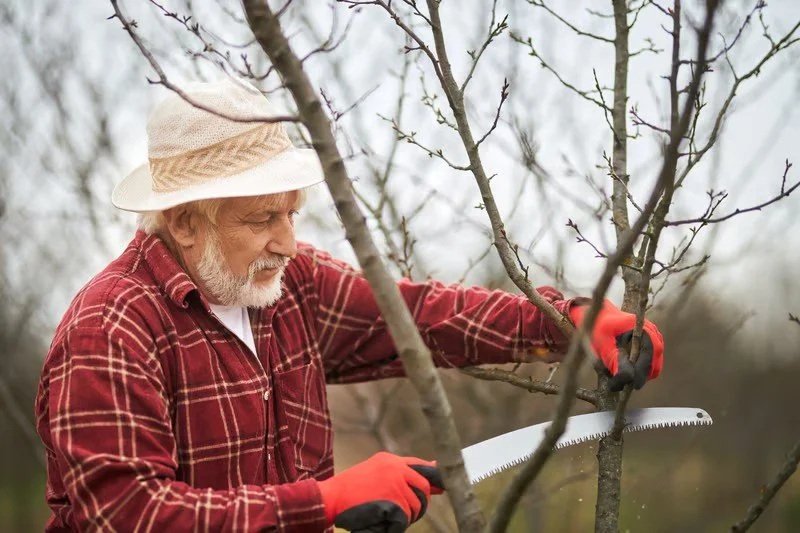
Tools: Loppers for annual reduction and stooling of stems up to 2 inches. Pruning saw for thick old stems on neglected specimens. Hand pruners for light thinning and dead wood removal.
Varieties Worth Growing
Purple foliage dominates the market — but the green and native forms have their own appeal
For most Seacoast gardens, 'Royal Purple' or 'Velvet Cloak' with the tiered renewal approach delivers the combination of dramatic purple foliage, manageable 6-8 foot height, and visible smoke plumes. 'Grace' produces the most spectacular stooled foliage (enormous wine-red leaves) but grows the most vigorously and needs the most aggressive height management. 'Young Lady' is the best choice if smoke is the priority over foliage color — it blooms on younger wood than other varieties and stays naturally compact. Full sun (6+ hours) is essential for the deepest foliage color on all purple varieties; shade shifts them toward muddy green.
| Variety | Natural Size | Foliage & Smoke |
|---|---|---|
| 'Royal Purple' | 10-15 ft × 10-12 ft | Deep purple-black foliage; pink-purple smoke; the classic; needs height control |
| 'Grace' | 12-15 ft × 10-12 ft | Largest leaves; wine-red; C. coggygria × C. obovatus hybrid; vigorous; pink smoke |
| 'Velvet Cloak' | 10-12 ft × 8-10 ft | Deep purple; holds color through summer better than most; pinkish smoke |
| 'Golden Spirit' | 8-10 ft × 8-10 ft | Chartreuse-gold foliage; pink smoke; unique color alternative; less vigorous |
| 'Young Lady' | 6-8 ft × 5-6 ft | Green foliage; heavy pink smoke on compact frame; blooms young; least pruning needed |
| C. obovatus (American) | 20-30 ft × 15-20 ft | Native tree form; green foliage; best fall color of any smokebush; smoky plumes; needs space |
Foliage, Smoke, and Height FAQ
The questions that come from owning a plant this dramatic
-
Yes — smokebush is extremely forgiving of hard pruning and resprouts vigorously from old wood, even from a complete stool cut to 6-12 inches. A neglected 12-foot specimen can be reduced to stumps in March and will push 5-8 feet of dramatic new growth by July. You'll sacrifice that summer's smoke display (no old wood left to bloom on), but the foliage on the new shoots will be the deepest, most saturated color the plant has shown in years. The following March, transition to the tiered renewal approach to start building both foliage and smoke back into the framework.
-
Partial color fade through summer is normal, especially on older wood carrying smaller leaves. Two factors make it worse: insufficient sun (purple pigment requires full direct light to maintain intensity) and lack of renewal pruning (old stems produce progressively less-saturated foliage each year). The tiered approach corrects both by constantly cycling new, deeply pigmented stems into the framework. Varieties like 'Velvet Cloak' hold purple color through summer better than 'Royal Purple,' which tends to bronze earlier. If the plant receives fewer than six hours of direct sun, no pruning approach fully compensates.
-
Yes, and the single-trunk or multi-trunk tree form is how smokebush grows naturally if left unpruned. Select three to five strong trunks, remove all others at ground level, and limb up the lower branches to create a canopy at eye level or above. The smoke plumes are spectacular on a tree-form plant because they cascade downward from the crown. The trade-off: you give up the intensely colored large foliage that stooling or tiered renewal produces, and the plant needs 10-15 feet of vertical space and a similar spread. This is the approach for large gardens where smokebush can serve as a specimen tree rather than a managed shrub in a border.
-
Moderately. Deer generally browse smokebush less than many other deciduous shrubs, but it's not immune — young regrowth after stooling is tender and more vulnerable than mature wood. In areas with heavy deer pressure, protect stooled plants with temporary fencing through May until new growth hardens. Once stems reach three to four feet and begin to lignify, deer interest drops significantly. 'Royal Purple' and other purple-leaved varieties are slightly less palatable than green forms, though this is anecdotal rather than research-confirmed.
Foliage and Smoke on the Same Plant, Every Year
Whether your smokebush has outgrown its space, lost its foliage color, or never produced the smoke you expected, the tiered renewal system can deliver both — we'll set it up and show you the annual cycle.
Contact Us