

Yew Pruning Guide
The most forgiving evergreen in the landscape—and the one most often denied its natural form
The Evergreen That Forgives
Why yew is the opposite of every other needled shrub in your foundation
Yew (Taxus) possesses a biological trait that separates it from virtually every other needled evergreen in the Seacoast landscape: it regenerates readily from bare old wood. Cut a yew to 12-inch stumps, and dormant buds along those stems will activate and push new growth within weeks. Cut an arborvitae, pine, or spruce the same way, and you have a dead plant. This single regenerative capacity makes yew the most forgiving foundation evergreen available—and paradoxically, the one most often trapped in a form that squanders its potential.
That form is the meatball. Decades of annual shearing have compressed thousands of Seacoast yews into tight geometric balls, cubes, and cylinders that bear no resemblance to the plant's natural architecture: graceful horizontal tiers of dark green foliage, layered like the branches of a mature cedar, with depth, shadow, and filtered light moving through the canopy. The sheared meatball replaces this with a dense outer shell two inches deep, backed by bare brown wood, blocking all interior light and creating a featureless green mass that demands constant maintenance to preserve a shape the plant never wanted.
Need an experienced hand to help with your yew? Call Expert Pruning at (603) 999-7470.
Our Master Gardener-led team approaches yew as a restoration opportunity. Because the plant forgives aggressive correction, the question is never can we fix it—it's whether the homeowner wants formal geometry (valid, high-maintenance) or natural layered form (lower maintenance, more architectural presence). We help make that decision, then execute the transition or renovation with confidence that the biology supports whatever path we take.
Two Paths: Layered Architecture or Formal Geometry
An aesthetic decision with maintenance consequences
❦ Natural Layered Form
Yew's native growth pattern produces horizontal tiers of foliage—distinct layers separated by visible branch structure, each tier receiving filtered light from above. The silhouette is irregular, composed, and deeply architectural. This form requires selective thinning once or twice annually (March or June-July): remove interior branches to maintain separation between tiers, thin crossing and inward-growing wood, and allow the plant's horizontal branching to express itself. Lower maintenance than formal shearing, better interior light distribution, and a result that reads as garden composition rather than topiary.
❦ Formal Shearing
Tight geometric shapes require shearing one to two times per season (June, optional July-August). Remove 2-6 inches of current growth, maintaining slight taper (top narrower than base). Yews tolerate formal shearing better than most evergreens because they resprout readily if you accidentally cut too deep—a luxury arborvitae doesn't offer. The trade-off: dense sheared surfaces block interior light, require ongoing commitment, and produce the featureless mass that defines most over-maintained foundation plantings. Formal geometry is a valid choice for properties with deliberate architectural intent, but it should be a conscious commitment, not a default.
❦ Transitioning from Meatball to Layered Form
Stop shearing entirely for one to two growing seasons. The plant pushes irregular new growth beyond the old cut line—this looks messy, and that's the necessary first phase. The following spring, begin selective thinning with hand pruners: identify the strongest horizontal branches and remove competing vertical shoots, interior congestion, and anything that obscures the emerging tiered structure. Thin 20-25% of the canopy per session, focusing on opening space between horizontal layers so filtered light reaches each tier independently. The transition takes three to four years before the plant reads as intentionally layered rather than neglected. The result is a specimen that commands more visual presence than the meatball ever did—with half the annual maintenance.
Renovation: Using Yew's Regenerative Power
The aggressive corrections that only yew can survive
❦ Moderate Reduction (30-50%)
Timing: Late winter (March) before growth begins.
Cut branches back to desired size, reducing height and width by one-third to one-half in a single session. Unlike arborvitae or boxwood, you can cut into completely bare old wood—dormant buds along the stem activate and push new growth within 6-8 weeks. Make cuts to lateral branches where possible for a more natural recovery profile. Success rate: 90%+. New growth fills in over one to two growing seasons, restoring full foliage density at the reduced scale.
❦ Hard Renovation (70-90% Removal)
Timing: Late winter (March).
Cut the entire plant to 12-24 inches above ground with a pruning saw. The plant will look like a cluster of brown stumps for several weeks. New green shoots emerge from dormant buds by mid-May, growing 12-24 inches the first season. Second year, these shoots branch and begin filling. By year three to four, the plant has regained attractive form at its new scale. Success rate: 95%+ even on specimens fifty years old or more—dramatically higher than hard renovation on boxwood (60-70%) or mountain laurel (75-80%).
Post-renovation thinning: Hard-cut yews typically produce 20-30 new shoots from each stump. In the second spring, select 10-15 of the strongest, best-positioned shoots and remove the rest. This prevents a congested thicket from replacing one structural problem with another, and guides the new framework toward the layered architecture you're ultimately building.
🛠️ Tools and Safety
Hand pruners (bypass): For selective thinning, natural form development, and detail work. Essential for the layered approach. Sharp blades are critical—yew wood is dense and hard.
Hedge shears / powered trimmer: For formal shearing only. Smooth sweeping passes maintain consistent geometry.
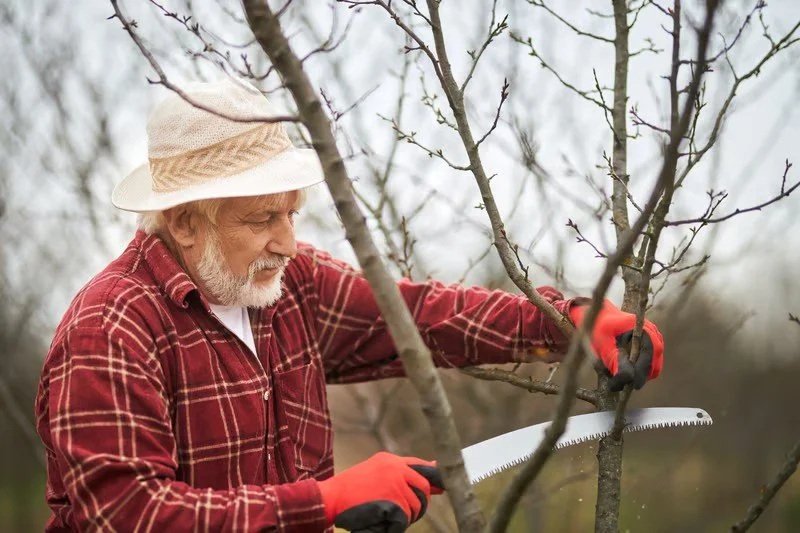
Pruning saw: For hard renovation—cutting thick old stems down to stump height. Curved Japanese-style blade handles dense yew wood efficiently.
Toxicity warning: All parts of yew (needles, stems, bark, seeds) are toxic if ingested. Wear gloves, wash hands after pruning, bag all clippings, and keep debris away from dogs, horses, or livestock. Dispose in household waste, not compost accessible to animals.
Common Yew Forms and Their Scale
Matching the growth habit you have to the space you need
All yews regenerate from old wood regardless of species or variety—the pruning biology is identical across the genus. The critical variable is mature form: spreading types grow wider than tall, upright types grow tall and narrow. Most overgrowth problems trace to a spreading variety planted in a narrow space or an upright variety left unchecked for decades.
| Variety | Mature Form | Renovation Notes |
|---|---|---|
| Japanese Yew (species) | 10-15 ft × 15-20 ft (spreading) | Most common on older properties; excellent shade tolerance; frequently overgrown |
| 'Densiformis' (hybrid) | 3-4 ft × 6-8 ft (low mound) | Rarely needs renovation; naturally stays in scale for most foundation positions |
| 'Hicksii' (hybrid) | 10-12 ft × 3-4 ft (columnar) | Most common hedge yew 1970s-1990s; excellent for narrow formal hedges |
| 'Brownii' (hybrid) | 6-9 ft × 8-12 ft (rounded) | Naturally rounded; good foundation accent; moderate renovation candidate |
| 'Capitata' (upright Japanese) | 25-40 ft × 15-25 ft (pyramidal) | Grows very large; prime candidate for hard renovation on old properties |
| 'Tauntonii' (hybrid) | 3-4 ft × 6-8 ft (low spreading) | Excellent winter color; compact; minimal pruning needed |
| English Yew (T. baccata) | 30-60 ft × 15-25 ft (upright) | Less cold-hardy (Zone 6+); classic formal hedge; uncommon on residential sites |
'Densiformis' and 'Tauntonii' represent the lowest-maintenance yew options—naturally compact forms that rarely outgrow their positions. 'Hicksii' remains the premier hedge yew where narrow columnar screening is needed. 'Capitata' and species Japanese yew on older properties are the varieties most frequently requiring hard renovation, and they tolerate it superbly.
Renovation and Form FAQ
The questions that arise when yews have been sheared for decades or outgrown their space
-
The natural form isn't inside the current plant—it's in the new growth that emerges once you stop shearing. Decades of geometric cutting have created a dense outer shell with no interior foliage or discernible branching pattern behind it. The recovery process starts by letting the plant grow freely for one to two seasons, then selectively thinning the new growth to reveal and encourage horizontal tiers. The original meatball wood becomes the hidden interior scaffold; the new growth becomes the visible layered canopy. It takes three to four years, but the plant you end up with has more character and requires less work than the meatball it replaced.
-
Light annual trimming of a fifteen-foot yew blocking a six-foot window removes the current year's growth but never solves the underlying scale problem—you're maintaining an oversized plant at an oversized dimension indefinitely. Because yew tolerates aggressive reduction with a 95%+ survival rate, decisive cutback to the correct size in a single March session accomplishes in one morning what incremental trimming never achieves. The plant looks bare for one season, vigorous by the second, and fully restored by the third—at the size it should have been all along.
-
Gradual yellowing and thinning on yew almost always indicates root rot (Phytophthora) caused by poor drainage, not a pruning deficiency. Yews demand well-drained soil—they are one of the few evergreens more likely to die from wet feet than from cold. Check the site: heavy clay soil, low spots where water collects, or downspout discharge near the root zone all create the waterlogged conditions root rot exploits. If roots are brown and mushy (healthy roots are white-tan and firm), the plant is in serious decline and pruning cannot correct it. Improve drainage or replace with a species tolerant of wet conditions.
-
Dense, unthinned yew canopies block nearly all light from reaching the ground, and their shallow fibrous roots occupy the entire soil zone beneath. Thinning 20-30% of the interior canopy—particularly removing lower branches to raise the canopy skirt—transforms the understory from dead zone to dappled shade where pachysandra, vinca, or certain ferns can establish. The change is dramatic: a dense black mass becomes an elevated layered specimen with usable garden space beneath. If thinning alone doesn't admit enough light, raising the canopy by removing the lowest tier of branches entirely creates clearance and filtered light simultaneously.
Every Meatball Has a Specimen Inside It
If your yews have been sheared into submission for decades—or simply outgrown their welcome—we can assess the framework, plan the renovation, and unlock the layered architecture that's been waiting underneath.
Contact Us