

Pruning Safety Tips for Taller Shrubs and Small Trees
Pruning Safety Tips for Taller Shrubs and Small Trees
I was called out to a property in Dover a few years back on a Monday morning, the day after a homeowner had spent his Sunday trimming a crabapple. The tree was fine. He had a cast on his wrist and a story about an orchard ladder sinking into soft ground. He told me he had done the same job the year before without any trouble, which is exactly how these things usually go.
Pruning taller shrubs and small ornamental trees is some of the most satisfying work in a garden. It is also where most homeowner injuries happen, and almost always for reasons that were predictable before anyone picked up a tool. A little planning changes the odds considerably.
Look up before you look at the plant
Before you touch a branch, stand back and check what is around and above it. Overhead utility lines are the single most serious hazard on residential properties, and they are easy to miss when your eyes are on the canopy.
The rule here is simple and absolute. If a branch is within ten feet of an electrical line, the job is not yours. It belongs to a licensed arborist or to the utility company. Wood conducts electricity when it is wet, and a fiberglass pole pruner offers far less protection than people assume. Every fall on the Seacoast our morning fog leaves everything damp well past nine in the morning, which makes this more than a theoretical concern.
While you are looking up, note where the branch will fall. Limbs do not drop straight down. They pivot, they roll, and they catch on what is below them. Clear the landing zone, move the furniture, and make sure no one is standing in it.
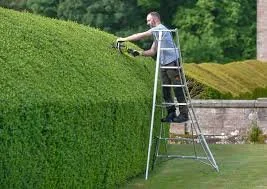
Ladders are where things go wrong
Most pruning injuries I hear about involve a ladder, and most of those involve soft ground.
Our coastal soils are sandy and they hold autumn moisture unevenly. A ladder foot that felt solid when you set it up can sink an inch on one side after twenty minutes of work, and that inch is all it takes. Set your ladder on a board or a solid plywood pad, check it again after you have been working a while, and never assume yesterday's setup is still valid today.
Use a tripod orchard ladder rather than a household stepladder if you have access to one. The third leg handles uneven ground far better, and the wide base is designed to sit in soft garden beds. Keep your hips between the rails at all times. The moment you find yourself leaning out to reach one more branch, come down and move the ladder. That extra reach is how people fall.
Never work from a ladder with a chainsaw. There is no safe version of that combination, no matter how small the saw or how brief the cut.
Match the tool to the branch
A great deal of ladder work disappears if you choose the right tool from the ground.
Hand pruners handle stems up to about half an inch. Loppers take you to an inch and a half. Beyond that you want a pruning saw, and a good folding saw will cut a three or four inch limb faster than most people expect. A pole pruner with a saw head extends your reach to twelve or fourteen feet, which covers the majority of ornamental tree work on a residential lot without ever leaving the ground.
Forcing an undersized tool is its own hazard. Loppers on a branch that is too thick will bind, then release suddenly, and that snap is how hands and faces get hurt. If the tool is straining, stop and get a saw.
Keep everything sharp. A dull blade requires more force, and more force means less control. Sharp tools also leave clean cuts that heal properly, which matters a great deal in our humid coastal climate where ragged wounds invite fungal infection.
The three cut method for real limbs
Any branch heavier than you can comfortably hold with one hand needs three cuts rather than one. Skip this and the limb will tear as it falls, stripping a long strip of bark down the trunk that the tree may never close over.
Make the first cut on the underside of the branch, about a foot out from the trunk, going a third of the way through. Make the second cut on top, an inch or two further out, and let the limb fall. Then make the final cut at the branch collar, that slightly swollen ring where the branch meets the trunk. Cut just outside the collar, never flush with the trunk. The collar contains the tissue that seals the wound.
Know where your limit is
There is one more piece of safety that has nothing to do with equipment. It is knowing when a job has outgrown you.
Anything above head height that requires a chainsaw, anything near a power line, anything over a roof or a driveway, and any tree with a visible crack, cavity, or heavy lean belongs to a professional with rigging, insurance, and training. The same goes for storm damaged wood, which holds tension in ways that are genuinely difficult to read.
If you are in Dover or anywhere across the Seacoast and you have a crabapple, dogwood, or tall shrub that has grown past comfortable reach, I would rather come look at it than hear about it after the fact. Fall is a good season for this work, with the leaves thinning and the structure easy to read. Let us take care of it properly and keep you off the ladder.
Expert Pruning | Location: North Hampton, NH, Serving Seacoast NH and Southern Maine | Contact: info@expertpruning.com, (603) 999-7470
