

Prune Your Limelight Hydrangeas the Right Way for Strong Growth
Prune Your Limelight Hydrangeas the Right Way for Strong Growth
If there is one shrub that defines summer on the Seacoast, it is the Limelight hydrangea. From Portsmouth dooryard gardens to the shingled estates of Rye and North Hampton, these plants are everywhere and for good reason. Their chartreuse to cream blooms are generous, their structure is reliable, and they tolerate our coastal conditions better than most flowering shrubs. But every spring, we see the same mistake repeated up and down Route 1: homeowners cutting their Limelights too hard, too late, or not at all, and wondering why their plants look tired, woody, or overgrown.
Pruning Limelight hydrangeas the right way makes an enormous difference not just in bloom size and plant shape, but in long term health and longevity. This is not a difficult job, but it does require understanding how this particular shrub grows and flowers. Once you know the biology, the timing and technique become intuitive.
Why Limelight Hydrangeas Are Different
Limelight hydrangea (Hydrangea paniculata 'Limelight') blooms on new wood meaning it sets flower buds on growth it produces in the current season, not on last year's stems. This is the most important fact to understand before you pick up your pruners. Because of this, you have real flexibility in timing and you do not risk cutting off next summer's flowers the way you would with a bigleaf or oakleaf hydrangea.
This new wood habit also means that annual pruning is not just acceptable it is encouraged. Without it, Limelights become tall, open, and floppy, with blooms pushed out to the tips of long, weak stems that bow under their own weight. A properly pruned plant is compact, sturdy, and loaded with blooms from base to tip.
When to Prune on the Seacoast
In Zone 6b which covers most of our Seacoast communities, from Exeter and Stratham up through Kittery and South Berwick the ideal window for pruning Limelight hydrangeas is late winter to early spring, just as the forsythia begins to color up and before the hydrangeas break dormancy. Here, that typically falls between late February and mid April, depending on the year. You want the worst cold to be behind you but new growth not yet underway.
Avoid pruning in fall. While the plants are dormant by October, early pruning removes the dried flower heads that provide modest winter interest and some frost protection to the crown. Leave those stems standing through the winter, enjoy the papery texture against snow, and cut them back when the season turns.
How Much to Remove and Where to Cut
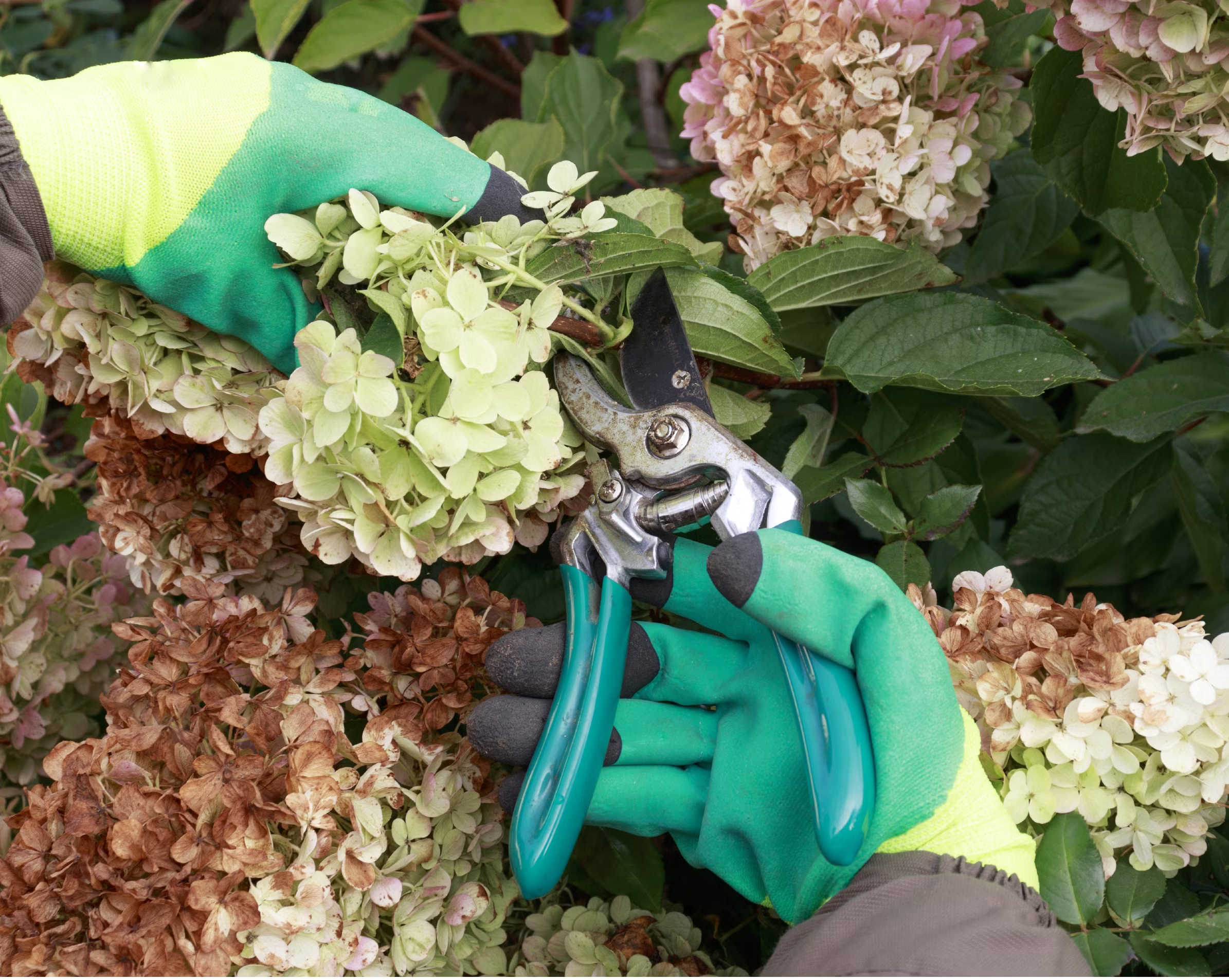
This is where many well meaning gardeners go too far. A hard cutback down to six or eight inches can work on an established plant, but it often results in a surge of weak, whippy new growth that falls over by August. A more controlled approach, and the one we recommend, is to cut stems back by roughly one third to one half, making each cut just above a healthy outward facing bud node.
Look for the small, paired buds that line the stems and choose a node about twelve to eighteen inches from the base as your target cut point on a mature shrub. Use clean, sharp bypass pruners for stems under half an inch in diameter, and a pruning saw or loppers for older woody canes. Always cut at a slight angle just above the node not flush, not leaving a long stub. On a shrub that has gone several years without pruning, consider a staged renovation over two seasons rather than a dramatic cutback all at once.
Aftercare That Makes a Difference
Once pruning is complete, take a few minutes to mulch around the base of the plant with two to three inches of shredded bark or wood chip mulch, keeping it pulled back from the crown. Our Seacoast soils often sandy, quick draining, and low in organic matter can dry out fast once summer heat arrives, and a consistent moisture supply directly affects bloom size and stem strength. A slow, deep watering once or twice a week during dry spells in June and July will reward you with larger, longer lasting flower heads.
If your hydrangeas are in a wind exposed location a beachside yard in Rye, a corner property in Hampton, a sloped garden in New Castle consider whether staking or a grow through support ring makes sense for the season ahead. Wind load on heavy panicles is a real factor in coastal gardens, and a little preventive support goes a long way.
Let Expert Pruning Handle It For You
If you are not sure where to start, or if your Limelights have been neglected for several seasons and need a careful renovation rather than a simple trim, this is exactly the kind of work we do every spring across the Seacoast in Portsmouth, Exeter, North Hampton, Greenland, Rye, and across the border into Kittery and Eliot. At Expert Pruning, we treat every shrub as an individual, reading its structure and growth habit before we ever make a cut.
