

Shaping Hedges for Summer Density: How to Get the Fullness Right
Shaping Hedges for Summer Density: How to Get the Fullness Right
A well-maintained hedge is one of the most structurally satisfying elements in a Seacoast garden. It defines space, creates privacy, buffers wind and salt air, and gives the property a sense of intention and care that no other planting quite replicates. But the dense, layered fullness that makes a hedge truly beautiful does not happen on its own. It is the result of consistent, well-timed shaping that works with the plant's natural growth rather than against it. Getting that right is more nuanced than most homeowners expect.
Why Summer Shaping Matters More Than the Spring Cut
Most people think of hedge trimming as a spring task, and the spring cut does matter. But for many hedges in Seacoast gardens, it is the early summer shaping that determines how full and composed the hedge looks from June through October. After the flush of spring growth extends the hedge outward and upward, a well-timed summer cut encourages the plant to redirect energy into lateral branching and interior density rather than continued outward extension. That lateral branching is what creates the thick, solid appearance of a hedge that looks genuinely full rather than just green on the outside with hollow, woody interior structure.
Know What You Are Shaping Before You Cut
Not all hedges respond to the same timing or technique, and this distinction matters enormously. Formal hedges planted with privet, hornbeam, yew, or beech are bred and selected for frequent shearing and will push dense new growth reliably after each cut. Informal hedges made from flowering shrubs like viburnum, forsythia, or native buttonbush have a completely different growth habit and should almost never be sheared, because shearing removes the flowering wood and destroys the natural arching form that makes them beautiful. Before you pick up a hedge trimmer, know what plant you are working with and what growth habit it has.
In North Hampton and across the Seacoast, the most common formal hedging plants are arborvitae, yew, privet, and boxwood. Each has specific preferences worth understanding before you cut.
The Right Time to Shape for Maximum Density
For most formal evergreen hedges on the Seacoast, the ideal summer shaping window is late June into early July, after the main flush of new growth has extended but before the stems have fully hardened off. Cutting during this window removes the soft extension growth and encourages a second flush of shorter, denser branching that fills in beautifully by August. Waiting too long into summer means cutting into harder, slower-to-respond wood, and the hedge may not have time to push and harden new growth before the growing season closes.
For arborvitae specifically, summer shaping should be light and focused on the outer surface rather than cutting back into old, interior wood. Arborvitae does not regenerate reliably from bare brown wood the way yew does, so each cut should land in green, active tissue.
How to Cut for Density Rather Than Just Size Control
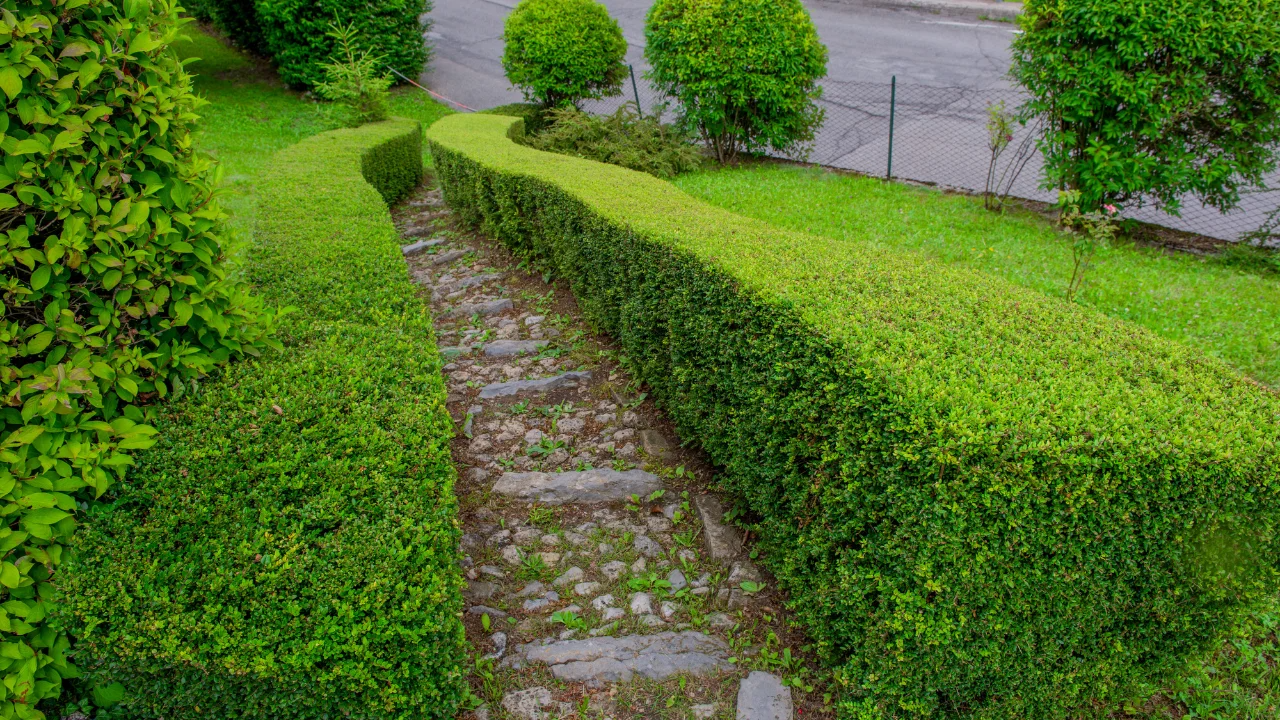
The angle and profile of the cut matters as much as the timing. A hedge that is sheared perfectly vertical on the sides will gradually develop a top-heavy profile that shades out the lower growth, producing thin, sparse base branches and a dense canopy that makes the problem worse each year. The correct profile tapers slightly, with the base of the hedge wider than the top, so that light reaches all levels of the plant equally. This is called battered shaping, and it is one of the most reliable ways to maintain a hedge that is full from the ground up rather than just at eye level.
Make each pass with the hedge trimmer smooth and consistent, working from the bottom upward on the sides and finishing with the top. Step back frequently to check your line and profile. Small corrections are easy. Large corrections require removing more material than you intended and can set the hedge back by a full season.
Do Not Skip the Interior
One of the most overlooked aspects of hedge care is managing what is happening inside the plant, not just on the surface. Dense outer growth on a sheared hedge gradually blocks light and airflow from reaching the interior stems. Over time this produces a thick outer shell with dead, bare wood inside, and the hedge becomes brittle, prone to snow and ice damage, and unable to recover from hard pruning when it eventually needs it.
Every two to three years, a formal hedge benefits from a light thinning of some of the interior branching, opening just enough space for light to penetrate and stimulate dormant buds on the older wood. This is not a dramatic process, but it makes a significant difference in the long-term resilience and density of the plant. A hedge that is only ever sheared on the outside will eventually hollow out, no matter how attentive the surface care has been.
Hedges and the Seacoast Environment
The Seacoast climate adds a few specific considerations that are worth keeping in mind throughout the growing season. Salt air and coastal wind create desiccation stress on the outer foliage of exposed hedges, particularly in winter and early spring. If your hedge faces southwest or is exposed to prevailing ocean winds, expect some dieback and browning on the windward side each year. Summer shaping gives you an opportunity to remove that damaged tissue and encourage fresh growth from behind it.
Sandy, fast-draining soils common throughout the Seacoast region also mean that hedges dry out more quickly than they would in heavier inland soils. A well-shaped hedge under drought stress will not push the new growth you are counting on after a summer cut. Deep watering before and after shaping, combined with a maintained layer of shredded bark mulch along the base of the hedge, gives the plant the resources it needs to respond well.
Avoid cutting hedges during heat waves or extended dry spells. Freshly cut tissue is vulnerable to desiccation, and a hedge trimmed on a 90-degree day in August without adequate soil moisture will struggle to recover cleanly.
When the Hedge Needs More Than Shaping
A hedge that has grown significantly out of bounds, developed serious gaps, or lost its lower density due to years of improper shearing may need staged renovation rather than a routine trim. Renovation pruning on an established hedge is a multi-season process that requires removing material in careful increments to avoid shocking the plant while encouraging new growth from the base and interior. This is not a task to rush, and the results of a well-executed renovation are genuinely rewarding.
Expert Pruning works with homeowners throughout North Hampton and across the New Hampshire Seacoast and Southern Maine to shape, maintain, and renovate hedges of all sizes and species. Whether your hedge needs a precise summer shaping or a longer-term plan to restore its structure and density, we are the team to call.
Contact us to schedule a visit.
info@expertpruning.com (603) 999-7470
